Learning piano after 70: is it too late?
No, it isn't too late. An honest look at what older beginners can realistically play, what's harder, what's easier, and how a first lesson goes.
By the Home Happenings team · October 7, 2026
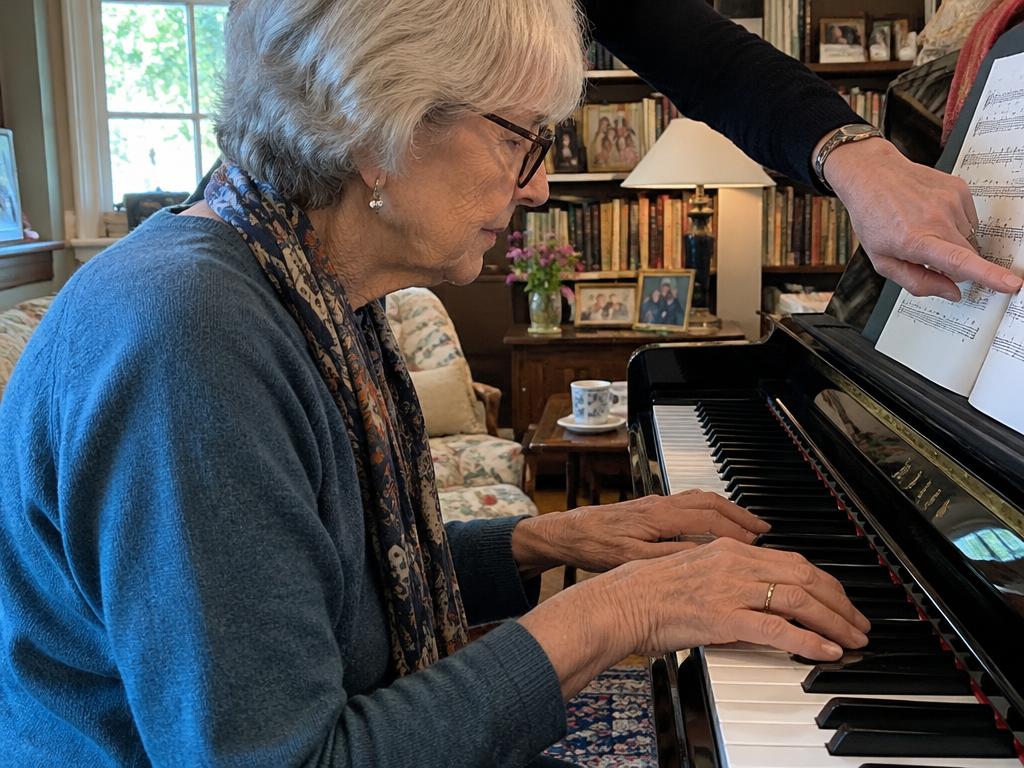
No. It isn't too late. People start piano in their 70s and 80s, and plenty of them end up playing music they love, for themselves and for the people around them.
But "it's never too late" is the kind of thing printed on greeting cards, and you deserve a more honest answer than that. So here's what actually happens when you learn piano later in life: what's easier than you'd expect, what's harder, and what a realistic first year looks like.
What you probably won't do
Let's get this out of the way. If you start at 72, you probably won't play Rachmaninoff. You won't be booked at Carnegie Hall. You likely won't develop the lightning fast fingers of someone who practiced scales from age six.
That's fine. Almost nobody who starts as a child gets there either. Most people who took lessons as kids quit by high school and can't play much of anything now.
What you can realistically do
Here's what's very reachable for a beginner over 70 who practices a little most days:
- Within a few weeks: find your way around the keyboard, read simple notes, play short melodies with one hand
- Within a few months: play simple pieces with both hands, including songs you actually recognize
- Within a year: play arranged versions of favorite songs, hymns, show tunes or standards, well enough to enjoy them and play them for someone else
- Over a few years: keep improving, try harder arrangements, maybe play a duet with a grandchild who's taking lessons too
The pace depends on how often you practice, if you played anything before, and honestly how much fun you're having. Fun keeps people going longer than discipline does.
What's harder for older beginners
Some things are genuinely harder later on, and it's better to know going in.
Fingers can be stiff. Arthritis, or just decades of not using your hands this way, can make some stretches uncomfortable. A good teacher picks pieces that fit your hands rather than forcing your hands to fit the piece. Lots of simple arrangements stay within a small range of keys.
Getting two hands to cooperate takes patience. Making the left hand do one thing while the right does another is the classic wall. It's a wall for 8 year olds too. Adults just notice it more, because adults are used to being good at things.
Memory may work differently. You might find reading the music easier than memorizing it. That's fine. Nobody's taking away your sheet music.
Frustration hits harder. Kids expect to be bad at things. Adults often don't. The first few weeks of sounding clumsy can be the hardest part, more emotionally than physically.
What's easier for older beginners
Here's what people don't mention: in some ways you're better set up than a child.
You know why you're there. Nobody's making you. You picked this, and that makes practice feel different.
You already understand music. You've been listening for seventy years. You know how a song should sound, where it's going, when it's right. Kids don't have that.
You can focus. Twenty minutes of attentive practice beats an hour of distracted noodling, and adults tend to be better at the attentive kind.
You choose the music. You don't have to play "Hot Cross Buns" for a year. A teacher can get you to a simplified version of a song you love surprisingly fast.
Is it good for the brain?
You've probably read that learning an instrument is good for the brain. Researchers have been interested in that question for a long time. We'd put it modestly: learning something new and a little hard, with your hands, ears and eyes all working together, is a good way to keep your mind busy. Piano doesn't come with a medical promise, and it isn't a treatment for anything.
Start because you want to play. The rest is a bonus.
What a first lesson looks like
If you take lessons at home, the teacher comes to you. A first lesson usually goes something like this:
- A conversation about what you'd like to play, any history with music, and how your hands feel
- A look at your instrument (a keyboard with weighted keys is fine for starting, and an old piano may need tuning)
- Finding middle C, and learning the pattern of black and white keys
- A first simple melody, often within the first half hour
- A short, realistic practice plan for the week
Most people leave the first lesson having played something. It's usually more than they expected.
Practicing without it becoming a chore
A few habits that help older beginners:
- Practice short and often. Fifteen or twenty minutes most days beats two hours on Sunday.
- Keep the instrument somewhere you walk past. If the keyboard lives in a closet, you won't play it.
- Start each session with something you can already play. End with something you enjoy.
- Record yourself once a month. Progress is hard to notice day to day and easy to hear across months.
If recording on your phone sounds daunting, a tech help visit can show you how to film a quick video in a few minutes.
Do I need a piano?
Not to start. A decent 88 key digital keyboard with weighted keys works well, takes up less room, and has a headphone jack if you're worried about the neighbors. If there's an old family piano in the living room, get it tuned before the first lesson. A badly out of tune piano makes everything sound wrong, and that's discouraging for anyone.
Lessons at home
On Home Happenings, piano and guitar teachers come to homes in Essex County, in towns like Montclair, West Orange and Livingston. Teachers set their own hourly rate between $50 and $150. You can message a teacher before booking and ask whether they've worked with older beginners. It's a fair question, and a good teacher will be glad you asked.
If you're reading this for a parent, lessons make a lovely present. Our gift page explains how gift cards work.
So, is it too late?
No. You won't be a concert pianist, and you don't need to be. You can learn to play music you love, at your own piano, in your own living room, at your own pace. That's worth starting at any age. If you'd like to look at teachers, the music lessons page is a good place to begin.
Related activities
Find a local pro
Checked and vetted professionals who teach at home across Essex County.
Browse professionals