Talking to families about isolation: a guide for social workers
How to raise isolation with families without blame, what to suggest for different situations, and short scripts for the family call.
By the Home Happenings team · October 8, 2026
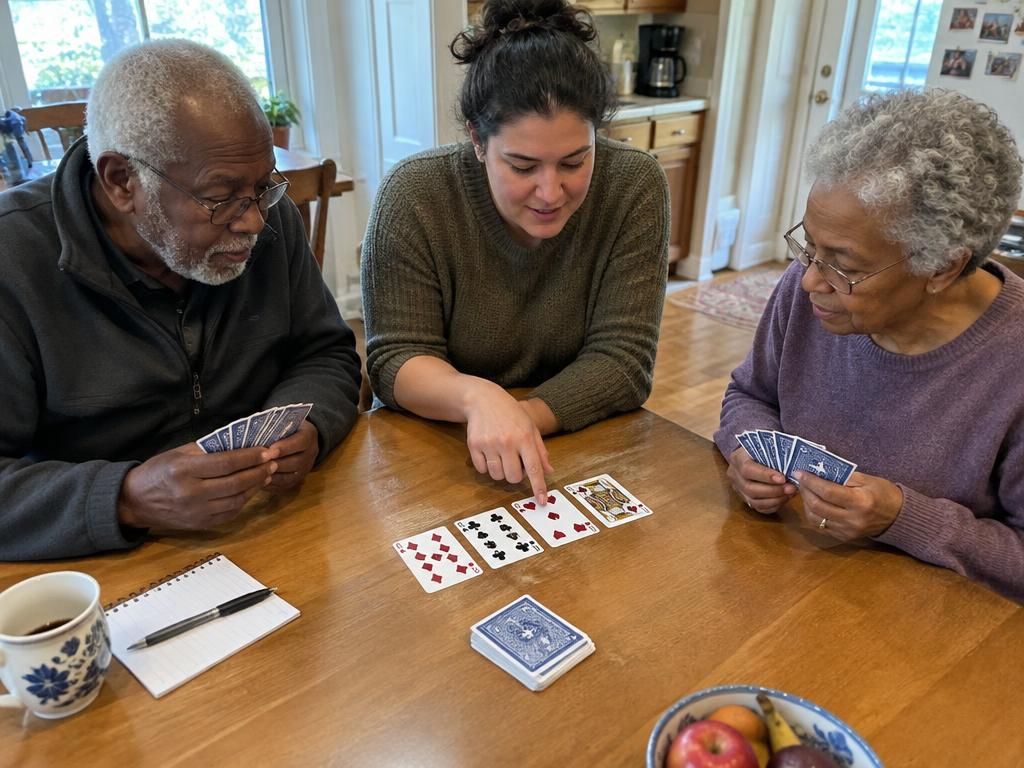
Most families don't call you about isolation. They call about a fall, a missed medication, a parent who stopped driving. Isolation comes up sideways: "She's fine, she just doesn't really go anywhere." "He watches TV most of the day." "Most of her friends have passed."
That sentence is your opening. This guide is for social workers, geriatric care managers, discharge planners and home care agency staff in New Jersey who want a plain way to raise isolation with families, suggest something concrete, and keep the conversation from turning into guilt or defensiveness. It isn't clinical guidance, and it doesn't replace your own assessment tools or your agency's protocols. It's a set of phrases and options that hold up in real conversations.
Why it's hard to bring up
Families hear "isolated" as an accusation. An adult son in Ohio hears "you haven't visited enough." A spouse who is home every day hears "you aren't enough." The older adult may hear "you think I'm pathetic."
So it helps to name the thing without assigning blame. Isolation is usually the result of small, reasonable changes stacking up: giving up the car, a hearing aid that never quite worked, a bridge group that shrank, a spouse's death, a move to a smaller place. Nobody did anything wrong. The week just got emptier.
The U.S. Surgeon General's 2023 advisory, "Our Epidemic of Loneliness and Isolation," gives professionals some useful cover here. You can mention that the federal government now treats social connection as a real health topic, without quoting numbers at a family that is already stressed.
Openers that tend to work
Start with the week, not the feeling. People are far more willing to describe their calendar than their loneliness.
- "Walk me through a normal Tuesday for your mom. Who does she talk to?"
- "When was the last time he did something just because he enjoys it?"
- "What did she used to love doing that she's stopped?"
- "If you could add one thing to his week, what would it be?"
With the older adult directly, keep it about preference and control:
- "What do you miss doing?"
- "Is there anything you always wanted to learn and never had time for?"
- "Would you rather have people come here, or go somewhere?"
That last question matters. A lot of suggestions fail because they assume the person wants to go out. Some people never liked groups. Some can't manage the transportation. Some are embarrassed about hearing loss in a loud room. Knowing which kind of person you're talking to saves everyone a failed attempt.
Phrases to avoid
A few things reliably shut the conversation down:
- "She needs to get out more." It sounds like a verdict, and it skips over why she isn't.
- "Senior center" as the first and only idea. For many clients the phrase itself is the obstacle. Offer it as one option among several.
- "Just for a little social time." People want a reason. Learning chess or getting the garden back is a reason. Socializing is not.
- Talking about the client in the third person while they're in the room. It happens more than any of us like to admit.
What to suggest, by situation
The best suggestion matches the reason the week got small.
Lost transportation. Solve rides before activities. In Essex County, the Division of Senior Services runs a transportation program for older and disabled adults, and NJ Transit Access Link serves people whose disability keeps them off the regular bus. A client who can get to the library or a county lunch site may not need anything brought to the house.
Won't do groups. Try one-on-one activity at home: a weekly lesson, a regular chess partner, a gardening session. The structure of "someone comes Thursday at 2" does a lot of the work on its own.
Lost a spouse or a regular group. Rebuild the specific thing. If Mahjong night ended, ask whether three neighbors or relatives would fill the table while someone teaches. Our board and card games page explains how that setup works.
Lost a skill to an injury or a change in health. Adapt it rather than replace it. Containers or a raised bed instead of kneeling in the yard. Chair yoga instead of a studio class.
Grief or low mood that worries you. That's a clinical question and belongs with the appropriate professional. An activity can sit alongside that, never instead of it.
A short script for the family call
Here's one version that keeps it practical:
"I want to raise something that isn't urgent but matters. From what you've told me, your dad's week has gotten pretty quiet since he stopped driving. That's common and it's nobody's fault. I'd like to add one thing he looks forward to. He mentioned he used to play piano. Would he be open to a teacher coming to the house once a week? We could try four visits and see how he feels."
Notice the pieces. It isn't urgent. It isn't anyone's fault. It's one thing, it's tied to something the person actually said, and there's a trial period. "Try four weeks" is much easier to agree to than "start lessons."
And with the client:
"Your daughter and I were talking about the piano. You said you miss it. Would you want someone to come play with you on Wednesdays? If you don't like it after a month, we stop."
Giving the client the exit up front is often what gets the yes.
Follow up on the right thing
When you follow up, ask about the activity, not the loneliness. "How's the chess going?" gets an honest answer. "Are you feeling less isolated?" usually gets "I'm fine."
Signs a suggestion is working tend to be small: the client mentions the visitor by name, has something to report, practices between sessions, or asks to move the time instead of cancelling. Signs it isn't: repeated cancellations, the family pushing harder than the client, or a personality mismatch. That last one is common and fixable. Try a different person before giving up on the idea.
Where Home Happenings fits
Home Happenings is one option for the one-on-one route in Essex County. Local pros come to the home to teach an activity: music, art, gardening, chair yoga, games, tech help and more. Every pro is background checked and vetted, and after each visit the pro writes a short note the family can read. Some families pass those notes along to the professional who made the suggestion. It isn't home health, therapy or a clinical service, and it shouldn't be presented as one.
If you'd like to see how it works before mentioning it to a family, how it works covers booking and cancellation, and why it matters is a short page you can forward. Questions from professionals are welcome through our contact page.
Related activities
- Board and card gamesMahjong, bridge, canasta, or someone to play a real game of chess with.
- YogaPractice gentle yoga and breathing with clear, personal instruction.
- GardeningPlant, prune and learn practical gardening skills at home.
- Music lessonsLearn an instrument, sing favorite songs or explore music at your pace.
Find a local pro
Checked and vetted professionals who teach at home across Essex County.
Browse professionals